Why oppose entry of an Israeli fossil fuel company into South Africa
Publication note: This speech was delivered by the Climate Justice Coalition’s elected Deputy Secretary Tara Nair van Ryneveld on 8 October 2026, during a webinar organised by the SA BDS Coalition, Natural Justice, Climate Justice Coalition and Masifundise Development Trust.
The webinar followed the September 2026 decision by the Petroleum Agency of South Africa (PASA) to grant offshore oil and gas rights in Block 1 CBK in the Orange Basin to Israeli company Navitas Petroleum, in consortium with Eco Atlantic and OrangeBasin Energies. In August, the four organisations had called on PASA and Minister Mantashe to withhold these rights, citing South Africa’s international legal obligations and its responsibilities to prevent transboundary and intergenerational harm to people, the climate and the environment.
There is a straightforward way we can answer this from a climate justice perspective. Burning oil, or any fossil fuel is the main cause of climate change, because it releases green house gases into the atmosphere, which warms our planet. And Southern Africa is a climate change hotspot, which means we will experience some of the worst impacts of intensifying climate change. Additionally, as a continent we contributed relatively little to causing the climate crisis. Burning fossil fuels is why 2025 was the hottest year on average, with 2026 set to exceed that. It is why Eastern Cape, KZN and Limpopo have experienced multiple severe floods over the past years, why winter rainfall in the Western Cape will increasingly dwindle and face multi-year droughts, and country wide we will experience increasing heatwaves.
Perhaps you might argue that South Africa cannot afford to be turning away foreign investment. I would respond that we have over 6000 abandoned mines in South Africa, growing levels of inequality and ridiculously high levels of youth unemployment. But these have happened in parallel to the continued expansion of natural resource extraction, the continued exploitation of our labour for profit that remains in the hands of an elite or is siphoned overseas by these foreign investors. And that is because we are all still located within global systems of colonialism and capitalism, where despite all the supposed political sovereignty on the continent and all the climate agreements, in 2023, 48 out of 55 countries on the African continent had new fossil fuel exploration or infrastructure development projects, predominantly conducted by foreign Global North fossil fuel companies, with the primary emphasis on export rather than addressing energy poverty on the continent. What we see is that these logics of pressuring and eroding connection to the land, for the purpose of extractive colonial development persists.
We often reiterate in the Climate Justice coalition, that Climate justice is economic justice, is human rights justice, is energy justice, food justice, land justice. This becomes clearer when you take a step back and ask, who profits from climate inaction, from climate injustice, from business as usual, from the continued extraction of oil, gas, coal? Climate change is the product of colonialism and capitalism. Oil is the lifeblood of capitalist development. The colonial project extracted resources from the global majority and burnt fossil fuels in Europe and America to power their new factories and industrial development, which generated profit that stayed circulating in the colonial centres. Independence on paper has not changed these entrenched relationships or drastically shifted where profit is channelled globally.
The fact that this is an Israeli company gives us even more reason to oppose this development, because Israel is one of the most obvious modern day faces of colonialism and capitalism working to undermine sovereignty globally.
Let’s think about what this oil would be used for, if the development went forward. It will power the Israeli occupation, whether through profits that flow back to Israel, or through oil that literally feed their factories, the growing Israeli settlements or their military activities. We already know Israeli military activity in Gaza, in Lebanon, Iran and the region has accelerated the climate crisis. Militaries are the single biggest institutional consumers of fossil fuels, making up 5.5% of global emissions-more than the African continent. This is probably an underestimate because the US lobbied under the Kyoto protocol against countries having to disclose their international military emissions, so we only have voluntarily disclosed numbers to go on. We know that some of the biggest profiteers from Israel’s war have been fossil fuel companies, like Total, Shell, Exxon, Glencore. The emissions released from bombarding Gaza were more than the annual emissions of over 30 most climate vulnerable countries. In the first two weeks of Israel’s war with Iran over 5 million tons of carbon was released.
Another possible pathway for this oil would be to power Israeli factories, such as those producing agrochemicals. Ironically the agrochemical industry literally emerged from world war 2, with companies rebranding chemical warfare. We see the weaponisation of agrochemicals and industrial agriculture in the way it is used to undermine food sovereignty, amongst Palestinians as well as regionally and globally. Earlier this year there were reports of Israeli planes sprayed chemical herbicides across Lebanon’s southern border, damaging kilometers of agricultural land and grazing areas. Israel’s enclosure of land and water have turned Palestine, the former bread basket of the Levant with thousands of years of indigenous agricultural practices, into a net importer of Israeli agricultural products. Simultaneously, Palestinians are forced to live alongside these toxic factories – that are shut down in Israel due to the health hazards and then moved to the west bank. And South Africa’s top import from Israel is pesticides, some of which are literally banned in the EU because they are carcinogenic, cause birth defects and other health issues. Apart from the fact that these then end up in our food, South Africa’s farm workers, who already exist in precarious often seasonal employment, are forced to use these chemicals with minimal protective equipment, leading to cancers, respiratory diseases and our own local public health crisis.
Or maybe the oil will go to power Israeli data centres and the growing weaponisation of AI and digital surveillance trialled on Gaza, and being rolled out globally to restrict and control us, our ability to independently advocate and build social movements, or just live our lives without constantly being analysed for the next product that can be sold to us.
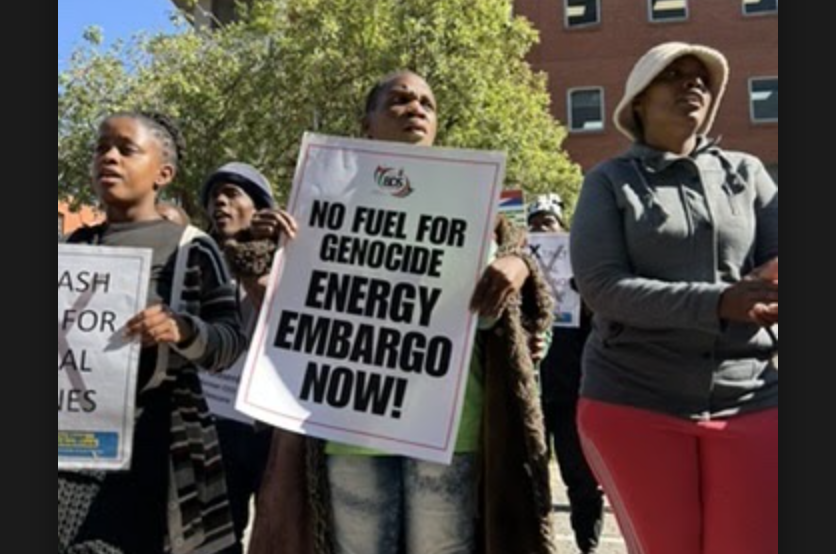
So it is clear that there are multiple ways that our struggles intersect. Solidarity is key. There is no climate justice without confronting colonialism, imperialism, ecocide and genocide. There is no climate justice without human rights justice. The systems of capitalism and colonialism underpin the climate crisis and the dehumanisation and oppression of peoples around the world, from Palestine to Congo, West Papua to Sudan, to the Afrophobia in South Africa. We must recognise and resist these systems and highlight the fundamental contradiction: systems built on exploitation and extraction of land, labour, ecosystems and our communities will not serve us justice so we must reject them. We must call for reparations for the climate debt owed to us. We must stop fueling Israel with our coal, with our oil, with our money. And we must remember, there is no climate justice until Palestine is free.