People’s Power Vol. 2: Communities across South Africa are organising for climate justice
People’s Power returns
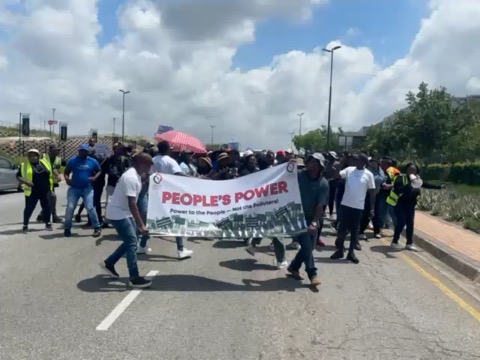
Following the broad-based People’s Power actions that took place across South Africa in September and October 2025, the Climate Justice Coalition (CJC) is gearing up for People’s Power Vol. 2, a week of action taking place from 19–26 October 2026.
This week of action will bring together CJC member organisations across the country to respond to the needs and concerns of their communities. Some are demanding affordable electricity and challenging austerity while others are exploring community-led solutions for water, food and energy. In all this, members are turning the call for climate justice into collective action.
People’s Power is about building the power of ordinary people to shape the decisions that affect their lives, challenge the systems that deepen inequality, and develop alternatives that put communities before profit.
Across provinces, communities are organising, learning from one another and demanding a future in which everyone has access to the resources they need to live with dignity.
From community struggles to collective power
South Africa’s climate crisis cannot be separated from the inequalities that shape people’s everyday lives. Rising electricity costs, unreliable water infrastructure, unemployment and the growing impacts of climate change place enormous pressure on working-class communities, particularly those already excluded from decision-making.
Communities are tired of simply waiting for solutions. They are organising, sharing knowledge and developing alternatives rooted in their lived experiences.
This is the spirit behind People’s Power Vol. 2. Bringing together workshops, community assemblies, teach-ins, creative activism and marches, CJC members are creating spaces for people to understand the challenges they face, organise around shared demands and build collective solutions.
This year, CJC member 350Africa.org launched their Energy For All campaign. The Energy for All campaign is calling for a transformational allocation of 350 kWh of Free Basic Electricity per month for eligible households, delivered through public renewable energy. This demand challenges an energy system that continues to place an unfair burden on poor households while leaving millions without adequate access to electricity.
The Energy For All campaign will join hands with People’s Power, merging their week of action with People’s Power Week as communities respond to the national campaign by connecting it to their everyday realities through local organising, political education and creative action.
People’s Power in action: Events across the provinces
From 19–26 October, CJC members will host activities across several provinces, bringing community members together to organise for affordable energy, climate justice and people-centred energy alternatives.
Free State
In the Free State, community organisations will combine environmental education and practical planning with collective action for energy justice.
19 October: Community activist training in Botshabelo
The Botshabelo Unemployed Movement will host community activist training as part of the Electricity for All campaign. It will support community members in understanding the campaign and strengthening capacity to organise for access to sufficient, affordable electricity.
21 October: Community assemblies and meetings for Electricity for All
The Botshabelo Energy Affordability Task Team (BEATT) will host a community assembly in Botshabelo. It will create space for residents to organise around electricity affordability and the Electricity for All campaign.
As part of their contribution to People’s Power week, Tshwaraganang Basadi Environmental Justice Network will also host a community meeting to build awareness and support for the campaign.
22 October: Climate justice and disaster risk reduction workshop
Working For Climate will host workshop on climate justice and disaster risk reduction. In it, participants will explore how communities can influence municipal planning and develop practical responses to local environmental challenges.
The aim is to develop a Community Climate and Alternative Economy Action Plan that can feed into municipal Integrated Development Plans (IDPs), Spatial Development Frameworks (SDFs), Local Economic Development (LED) strategies, budgets and disaster-risk priorities.
Potential initiatives include rainwater harvesting, water-leak detection and monitoring, wetland rehabilitation, and growing herbs and spices. These practical interventions can help communities respond to environmental challenges while supporting local livelihoods and resilience.
23 October: March for Free Basic Electricity
Working For Climate will lead community members to the streets to demand access to sufficient, affordable electricity. The march will bring the Electricity for All campaign’s demands into public space, highlighting the need for an energy system that serves people rather than deepening household hardship.
North West
23 October: Artivism workshops in Klerksdorp and Potchefstroom
In the North West, creative activism will help bring the Free Basic Electricity campaign into local communities.
Through visual and performing arts, the artivism workshops will create opportunities for community members to engage with the campaign, communicate its demands and explore how they can participate in the broader struggle for energy justice.
By using creative expression as a tool for organising, the workshops aim to strengthen solidarity between local communities and the national campaign, making the call for affordable electricity accessible, relevant and visible.
Mpumalanga
20 November: Electricity for All Community meeting
In Middleburg, the Middelburg Environmental Justice Network (MEJN) will convene a Electricity For All community meeting for People’s Power Week.
Limpopo
19 October: Community teach-in in Northam
In Northam, Limpopo, a community teach-in will explore practical tools for energy sufficiency and community-led green innovation.
Participants will learn to make wonderbags which can help reduce the energy needed for cooking. They will also learn about smart farming practices that use less water and approaches to growing food in containers.
The teach-in will demonstrate how accessible, locally appropriate solutions can help communities make better use of available resources while building knowledge and resilience.
By combining practical skills with political education, the event will connect everyday alternatives to the broader vision of People’s Power: communities having the knowledge, resources and collective power to shape their own futures.
19 October: Community activist training
Enviro Vito will also host a community activist training as part of the Electricity for All campaign. The training will support community members to understand the campaign and strengthen their capacity to organise for access to sufficient, affordable electricity.
Gauteng
24 October: United Front convene an anti-austerity Electricity for All rally.
United Front will host an Electricity for All Rally in Diepkloof on Saturday, 24 October. Communities can expect to discuss the impact of the electricity crisis on jobs and development. It is time for communities to talk solutions for a reliable and affordable energy supply.
Eastern Cape
21 October: Qunu Community Advice Office community meeting
In Qunu, the Qunu Community Advice Office will convene a Electricity For All community meetings their contribution to Peoples Power week.
Western Cape
24 October: Witzenburg Justice Coalition (WJC) community workshop
Attend WJC’s Electricity For All community workshop for People’s Power Week.
These activities will connect the experiences that member organisations are facing on the ground whether it is a national demand for affordable electricity or for creative ways to explore green innovation, all the while creating opportunities for residents to organise, share experiences and hold decision-makers accountable.
Building people’s power, together
People’s Power Vol. 2 is a reminder that climate justice is not something that can be delivered from above. It must be built with the people most affected by inequality, environmental destruction and the failures of our current economic and energy systems.
Whether through a march for Free Basic Electricity, a community assembly, a creative workshop or a teach-in on practical alternatives, each action contributes to a broader movement for a more just and liveable future.
By bringing local struggles together, the Climate Justice Coalition and its members are building connections between communities, strengthening collective demands and demonstrating that alternatives are possible.
From 19–26 October, communities across South Africa will be organising, learning and taking action. People’s Power is built from below — and climate justice begins with people having the power to shape their own futures.