
‘Eco-friendly, green, sustainable’ equal greenwashing?
By Lindokuhle Masango
In an era driven by climate urgency, consumers look for ways to be environmentally responsible by buying sustainable products. Companies are aware of this and try to manipulate them into buying products that will make them feel environmentally responsible. However, as “eco-friendly”, “green” and “sustainable” claims increase rapidly, a deceptive practice of greenwashing takes over the marketplace. This article provides insight on what greenwashing is, how to identify greenwashing and examples of greenwashing cases.
Fossil Ad Ban campaign manager, Lazola Kati says greenwashing refers to misleading advertising, particularly by fossil fuel companies that present their activities as environmentally friendly while concealing the harm they actually cause. “For many women and communities who have never encountered the term, greenwashing can appear as feel-good advertising that hides the destructive realities of fossil fuel operations,” said Kati.
Clear signs of greenwashing
“Greenwashing can be subtle, but there are clear signs that consumers can look out for,” said Kati. However, there are clear signs that consumers may look out for. Fossil fuel corporations make use of buzzwords like “eco-friendly”, “green”, “sustainable” and “carbon natural” to persuade consumers that they are being environmentally responsible to buy their product. Look beyond this vague language. Read the fine print, the bold claims “made with recycled material” often hides important qualifiers, only 10% is recycled. In addition, check for certification, genuine claims are supported by independent certifications such as Fairtrade, Forest Stewardship Council (FSC) and Energy Star. If there is no verifiable data or third-party validation, the claim may be greenwashing. Lastly, do a quick online research about the company. For example, on the search bar enter the company name plus greenwashing and the truth will be revealed.
Dangers of greenwashing
Greenwashing poses significant dangers to consumers, legitimate eco-friendly businesses and the planet itself. “Greenwashing deceives people and institutions into believing that certain brands and companies are environmentally responsible when they are not,” she said. This deception slows down genuine climate action and allows harmful practices to continue and present them as sustainability. It delays progress towards meaningful climate goals. When companies fabricate their environmental claims, it becomes difficult to identify truly sustainable efforts. Greenwashing enables continued environmental harm. Fossil fuel companies, mining, and fast fashion industries market themselves as “eco-friendly” to maintain their social license, this makes room for them to continue emitting greenhouse gases, damaging eco-systems and exploiting workers under the guise of “green” image.
Landmark examples of greenwashing
Below are some examples that demonstrate what greenwashing is and how rules and regulations have a role to fight greenwashing in South Africa and globally:
- In South Africa, the Fossil Ad Ban campaign launched Africa’s first greenwashing complaint against TotalEnergies and won.
- Volkswagen-Fined over $30 billion for using “defeat devices” to cheat emissions tests.
- FIFA-Found guilty in the European Union of falsely advertising the 2022 World Cup as carbon-neutral.
- H&M-Sanctioned in the Netherlands for misleading garment sustainability claims.
- Keurig Canada was fined $3 million by Canadian Competition Bureau for false claims about the recyclability of its coffee pods.
- Kohl’s and Walmart-Fined for falsely advertising rayon products as bamboo.
Why do companies greenwash?
“One of the reasons companies greenwash is to maintain their social license- the public acceptance needed to continue operating,” said Kati. Fossil fuel companies do this without meaningfully phasing out fossil fuel exploration and investment. This is a strategic advertising tactic designed to appear responsible while protecting profits and delaying the transition to clean energy.
Law or regulation of greenwashing
Currently, there is no specific law aimed at addressing greenwashing in South Africa. “Following the TotalEnergies complaint, the Advertising Regulatory Board (ARB) began developing a sustainability policy to ensure that advertisements do not mislead the public about a company’s environmental practices,” said Kati. Moreover, other countries have put in place laws to hold fossil fuel companies accountable for greenwashing. A greenwashing rule in the UK, the 2021 Green Claims Code, requires that environmental claims be truthful and accurate, clear and unambiguous, not omit or hide important information and to make fair and meaningful comparisons when applicable. To consider the entire life cycle of the product or service and be substantiated. This law applies to any claims aimed at consumers in the UK.
TotalEnergies case
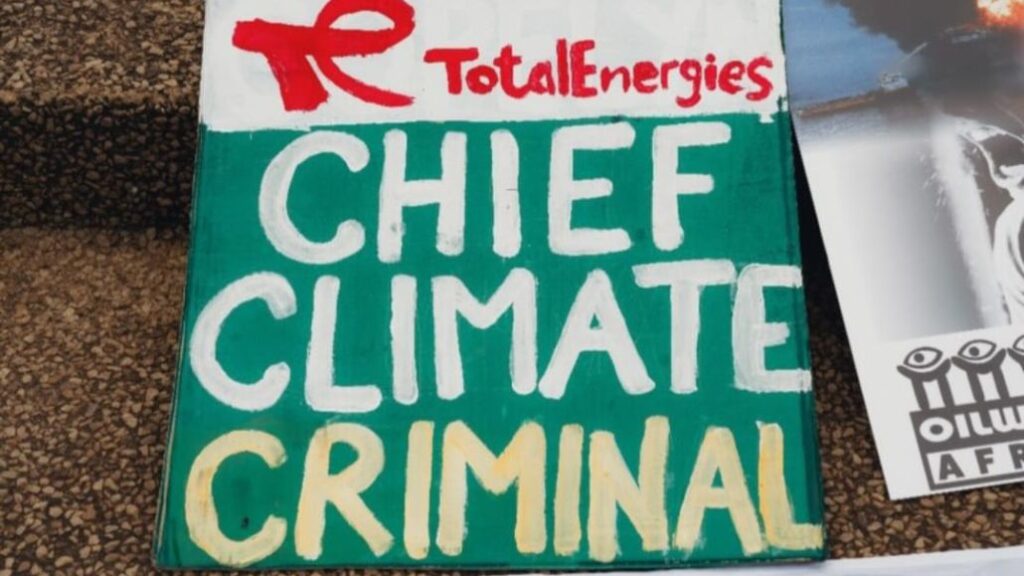
The TotalEnergies case is one of the examples that clearly shows how grassroots organisations and campaigns are fighting for environmentally justice and human rights. Fossil Ad Ban campaign filed a complaint against TotalEnergies and they won the case.
On 14 August 2024, the Advertising Regulatory Board (ARB) ruled that TotalEnergies’ claim “committed to sustainable development and environmental protection” was misleading. The claim was in an advertisement related to its partnership with SANParks.
While the ARB accepted that Total’s environmental protection claim was supported by its funding of conservation efforts, it could not justify the “sustainable” claim. The Directorate emphasized that Total’s core business-fossil fuel extraction and sales-fundamentally contradicts the principles of sustainable development.
On appeal, Total argued that its support for SANParks aligns with the environmental, social and economic pillars of sustainability through projects such as National Parks Week and the “Walk and Learn on the Wild side” programme. However, the Appeal Committee ruled that these initiatives did not demonstrate a company- wide transition to clean energy or a reduction in fossil fuel dependency. It found the statement exaggerated and potentially misleading. Concluding that Total’s partnership with SANParks was insufficient to substantiate a bold “sustainable development” claim. The appeal was dismissed and the directive prohibiting such advertisement remains in force.
According to Kati, if a company is genuinely sustainable and committed to fighting climate change, it should not have fear of transparency. Openness to public scrutiny encourages accountability, continuous improvement and genuine climate action that prioritises human and environmental safety.
The fight against greenwashing is a fight for a climate just future. It calls for companies to practise and embrace transparency and accountability. The government to implement and impose significant financial penalties for misleading claims and establish policies to govern the environmental claims marks. Lastly, consumers must be able to question and doubt claims. Demand credibility not only rely on the appealing visuals. This can lead to the environmental change that the planet urgently needs.
About the author: Lindokuhle Masango is an aspiring photojournalist from Carolina, Mpumalanga. A lover of capturing nature photography, history and reading fiction, Lindokuhle finds inspiration and motivation in stories — whether on the page or through the lens of a camera.